
There are several elements to consider when selecting a saw blade, the most important of which is the device on which it will be installed, as this determines the blade and shaft diameter. In order to select the appropriate blade, it is also important to determine its use, meaning the material to be cut, the direction of the cut in the wood, the desired finish, and the cutting speed.
You will find a large number of products in store: blades with a greater diameter, with a different number of teeth, and made from different materials. Some products, such as Exchange-A-Blade (EAB) products, also offer blade recycling programs. The concept is simple:
- Purchase a blade.
- When your blade needs replacing, return it to the store.
- Save up to 40% on your new blade.
- EAB will meticulously rework or recycle your blade.
This program is offered through several BMR dealers. Ask one of our in-store advisors for more details. In short, there are several elements to consider. Here are a few things to keep in mind.
Five elements to consider before purchasing your blade
Some blades are designed for various uses, while others are designed for specific tasks. A blade may also have the same use whether it is mounted on a table saw, a circular saw, a mitre saw, or radial arm. Some may be used on more than one device, but this is not always the case.
The manufacturer’s recommendation for equipment use and for blades usually appears on the tool’s packaging. If you don’t have access to this information, here’s how to find out whether your blade can be used on your saw and for which types of jobs:
Element #1: The blade’s diameter must correspond to the diameter recommended for your saw. In general:
- A 7¼" blade can be used with a circular saw, and an 8¼" blade can be used for some table saws or a small mitre saw.
- A 10" blade is most often used on a table saw and with a sliding mitre saw.
- Some mitre saws and radial arm saws require larger blades, i.e. 12" and up.
Element #2: The shaft’s diameter must correspond to your tool’s shaft diameter.
Element #3: The angle of attack should take account of your saw and the material to be cut, and follow the recommendations above. The angle of attack is considered positive when the tooth is tilted forward, and negative if it is pointed towards backward. Negative-angle blades are always used with radial arm or mitre saws.
Element #4: The maximum rotation speed must comply with your saw’s rotation speed.
Element #5: The blade’s total number of teeth will determine the thickness and speed of the cut: the more teeth, the finer the cut, and the fewer the teeth, the faster the cut, but without finish. If you need to cut thick wood, use a blade with fewer teeth. Use a blade with more teeth to cut plastic and metals.
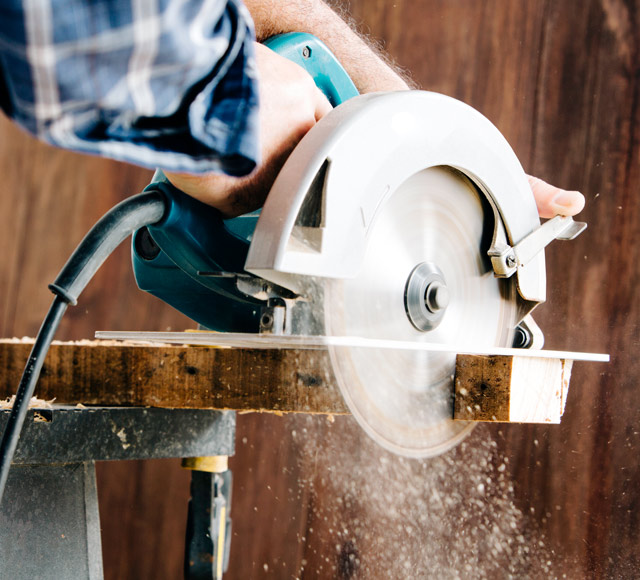
The highly versatile circular saw
The circular saw is a popular tool for working with wood, plastic, tiles, and metal. It can make straight cuts and cut through any thickness of material depending on the blade used, which is why it is so important to select the appropriate one.
1,500 revolutions per minute. Needless to say, at such a high rotational speed, it is absolutely essential to wear protective gloves when handling a circular saw. And because it makes a lot of noise, it is also recommended to wear a noise cancelling helmet when operating it.
Lastly, it is important to determine the type of blade:
- Steel blades
A steel blade is ideal for cutting wood or performing quick but less precise cuts. However, it must be re-sharpened often.
- Carbide blades
Choose a carbide blade for fast, accurate cuts. It is effective for cutting wood, melamine, laminate, or solid wood panels.
Multi-material circular saw blades are now available on the market. This type of blade will fit most circular saws of any brand. It is also available in several sizes depending on the material to cut.
If you need to cut against the wood fibres, opt for a blade with 48–80 teeth to limit the risk of splintering and imperfections. If you are cutting in the same direction as the wood fibres, a blade with 40 teeth or less will suffice.
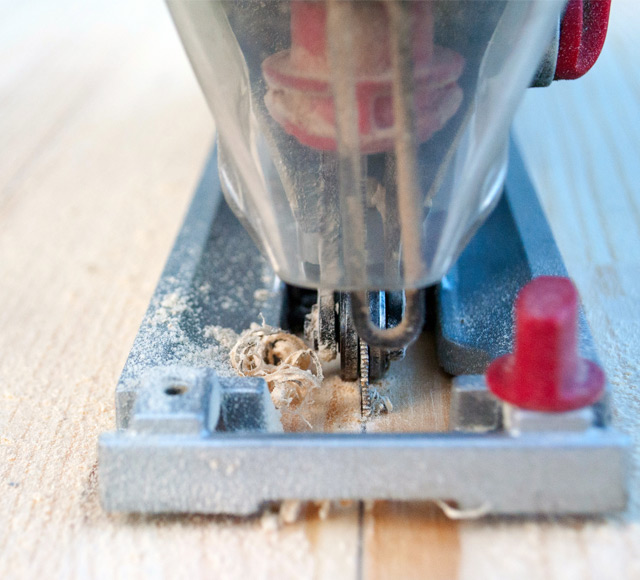
Reciprocating saw
The reciprocating saw is a motorized hand saw that makes manual sawing chores easier.
It allows for cutting in impossible-to-reach areas and in awkward positions. Depending on the blade selected, it can handle any kind of material: green wood, plastic, PVC, copper, plaster, steel, and more.
Both electric and cordless versions are available.
Though the electric reciprocating saw performs better than its cordless counterpart, the latter has the advantage of easily completing difficult and hard-to-access cuts, especially when there is no power source nearby. The cordless model is slightly heavier than the electric one.
Just like the circular saw, the choice of blade for the reciprocating saw is based on the material and type of cut desired. For example, there are specific blades for angled cuts, and others that are more flexible, which are ideal for making cuts close to a wall or a floor.
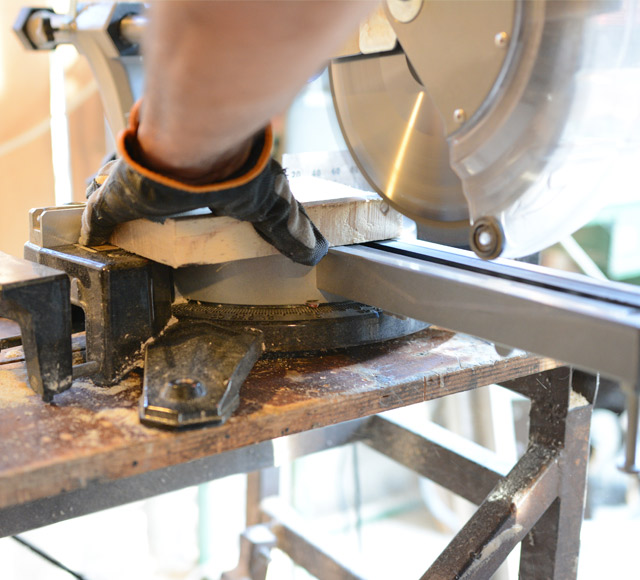
Mitre saw
When cutting baseboards or panelling, the mitre saw is second to none. Both the manual and electric versions can make 45° or 90° cuts.
The manual mitre saw is ideal for small jobs, while the electric mitre saw is preferable for cutting larger planks without any effort. It also lets you adjust the height and width of the cut.
Tooth shape
Saw blade teeth come in different shapes and configurations and are chosen based on the material to cut, the desired finish, and cutting speed.
Flat top/flat teeth: this blade offers a fast, efficient cut with a coarser finish. It is perfect for demolition work. This blade is fairly durable and affordable.
Alternate tooth bevel: the cut speed is slower, but it creates a smoother finish. It is recommended for cutting wood flooring slats, plywood, pine posts, and wood chipboard. A blade with a more pronounced tooth bevel cuts through wood, plywood, melamine, and composite materials without any effort.
Alternating tooth bevel with scraper/flat teeth: mainly for sawing and splitting all kinds of wood and wood-based materials.
Triple bevel: this blade yields better results when used with heat-sensitive materials such as melamine, hardwood, and MDF. It can also be used with aluminum.
Although this guide has enlightened you a bit more about your needs, you may need help to find your way around. Do not hesitate to talk to your advisor at your BMR dealer. This one can advise you the best blade to use according to your needs.